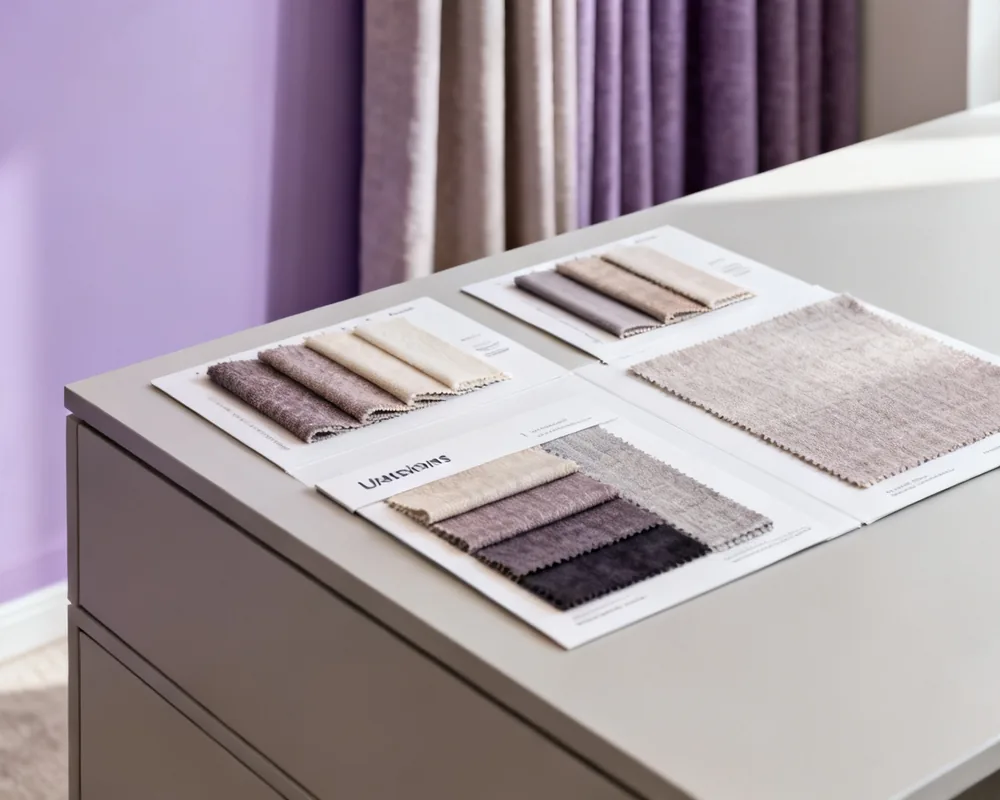
Begin with the room and a physical cutting before you narrow upholstery or curtain cloth.
Fabric selection guide
Begin with the setting
Describe the seat, the window, or the covered interior surface before you ask for a favourite cloth. Daily contact, the cleaning a building will actually run, daylight on a drape, and the way panels are cut all change the shortlist. A request for the best fabric is harder to answer than a note that says a reception sofa is wiped each evening and must keep a quiet hand. Several weaves can look close on a screen and still part ways once they are handled beside the foam or the lining.
Fabric selection guide — compare at least four dimensions
Dimension
Review question
Evidence or next step
Touch
Composition alone does not set the hand
Handle the weave and the finish on a physical cutting
Care
Maintenance can remove a cloth from the shortlist
Name the real cleaning method and any spot treatment
Exposure
Wear, light, and moisture are different stresses
Split abrasion, daylight, and liquid questions
Processing
Cutting and joining change what width is useful
Discuss usable width, edges, and seam behaviour
Handle the sample as information
Photographs help with colour direction and the scale of a texture. A cutting adds drape, thickness, and the way a nap or a metallised face catches light in the room. Write down the construction and finish you think you are comparing so the handling session answers one question. If two wool interior textiles feel different, note whether the difference is yarn, weave density, or a surface finish. That note is more useful than a preference recorded only as “softer.”
Compare the construction, not one label
A fibre name and a GSM describe part of a cloth. They do not fix pilling, seam slippage, or how a curtain stacks. Yarn count, weave, and finishing can move those results. When a performance need is central, ask for the method and the specimen state that belong to that need. A high-performance phrase without those fields is a prompt for a question, not a completed specification. Keep water behaviour and vapour movement apart if either one appears in the brief. Most interior seating questions are about surface wear and care, not about a membrane rating.
Prepare a shortlist with tradeoffs
More than one cloth can remain plausible. Set the priorities the room actually has: quiet hand, cleaning tolerance, daylight, and the width needed to cut panels without an extra seam. Say what is still unknown and what the next cutting should clarify. An explicit tradeoff keeps the inquiry actionable. It also avoids inventing a single winner for every interior. Price follows the specification. This guide does not stand in for a price list, a stock date, or a certificate.
Selection dimensions without a named rival
Five dimensions stay on the shortlist: handle on a physical cutting, care chemistry the building will run, exposure split into abrasion, daylight, and liquid, processing through usable width and seam slippage, and document scope through holder, date, and product coverage. Cloth options are compared on those dimensions. A supplier name from outside the brief is left out, because a name is not a measured difference in GSM, drape, or pilling.
Stock cloth and a custom development
A stock discussion starts from the cutting on hand, the shade lot, and whether a later roll of the same construction can be discussed. A custom discussion starts from a dated reference specimen, the property that must change, and the approval point before any bulk conversation. Stock does not prove a replenishment date. Custom development does not prove that a sample can be produced. Both paths still need fibre composition, mass in grams per square metre, and usable width in centimetres when those facts are known.
What the comparison cannot settle
Hand does not settle abrasion resistance. A quiet wool face can pill under a different method from the one used on a tighter synthetic weave. Stretch recovery, where the cover needs it, is a separate line from dimensional stability after cleaning. Air permeability is not a substitute for water vapor transmission. If a coating or a laminate is present, say which layer the sentence describes. Light colorfastness on a south-facing curtain is not a seating abrasion result.
Repeat the check in three steps. Place the cuttings under one light. Record fibre composition, weave construction, finish, and shade lot. Attach a report beside its method and specimen state, or leave the number blank. Another specifier can repeat that sequence. It does not replace a named laboratory method the parties have not agreed, and it does not publish a price.
Use this page to prepare a question, not to supply a measured result. Write the known material reference first, then the decision that is still open. Method, specimen and scope stay attached to any figure that is already in hand. Unknown points stay questions.
Notes to keep with the page
Note
Write this
Leave this open
Material
Composition, construction and finish if known
Any value that has not been confirmed
Decision
The comparison or approval the inquiry needs
A conclusion the record does not support
Evidence
Method, specimen and scope when a report exists
A label used without that context
Next step
The sample or document that would resolve the question